


Why People Tell AI About Their Debt — But Not You


There’s an assumption baked into contact centre design that rarely gets examined: when a conversation is sensitive, the instinct is to route it to a person. Debt, financial hardship, a missed payment – surely those need a human who can offer empathy and build trust?
The evidence suggests otherwise.
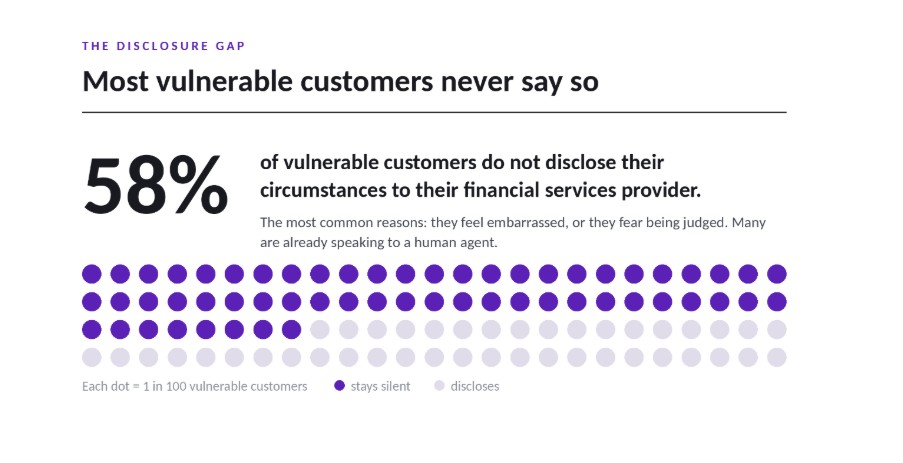
Drawing on the FCA’s own work, Grant Thornton found that 58% of vulnerable customers don’t disclose their circumstances to their financial services provider, most often because they feel embarrassed or fear being judged. Many of those customers are already on the phone to a human agent. So, the channel we trust to surface vulnerability frequently isn’t surfacing it at all.
This isn’t a new problem, and a better-trained agent won’t solve it on its own.
Why Financial Shame Suppresses Disclosure
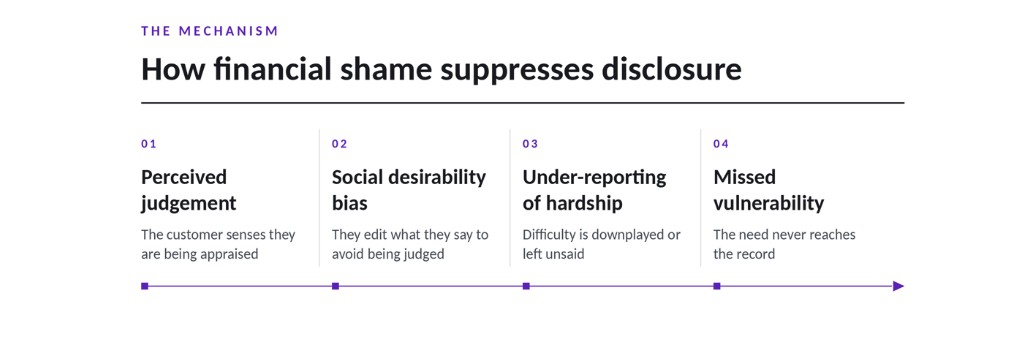
Decades of social psychology point to the reason. When people believe another person is evaluating them, they consistently under-report things like debt, financial difficulty and missed payments. Psychologists call it social desirability bias: we quietly edit what we say to avoid being judged, and a professional, sympathetic agent on the line doesn’t switch that instinct off.
A digital interface carries none of those evaluative signals. It doesn’t raise an eyebrow at a missed payment, and it holds no social standing over the person disclosing. Work by Clifford Nass and colleagues at Stanford helps explain what’s happening. People apply many of the same social habits to a digital voice as they do to a human one, but without the same anxiety about being judged. The conversation still feels engaging, while the inhibition that comes from facing someone who might judge you falls away.
When Poor Design Makes Things Worse
None of this is an argument for automating sensitive conversations and walking away. The evidence cuts both ways.
Automated systems that lack proper vulnerability detection have chased customers who were already in crisis, missed obvious signs of distress, and delivered responses that didn’t fit the situation. The FCA’s 2026 review of AI in retail financial services names this risk directly, warning about AI systems that influence decisions customers “do not adequately understand” without enough human oversight.
In most cases the problem is the design rather than the technology. A 2025 systematic review of human–agent interaction found that when an AI agent fails to live up to the expectations it sets, users report diminished trust and, at times, a visceral negative reaction. The commercial picture is sobering too: industry analysis reported that 42% of companies had abandoned most of their AI initiatives before they reached production, with 46% of proof-of-concept projects scrapped altogether. In a Consumer Duty environment, a failure rate like that carries regulatory consequences as well as commercial ones.
Route by Shame, Not Just Complexity
It suggests a routing principle most deployments still don’t apply, which is to weigh the emotional stakes of a call rather than just its category. Debt, hardship and missed payments all carry shame, and shame is exactly where a non-judgemental AI voice channel can surface what a human channel often can’t and do it at scale. The FCA’s Consumer Duty approach expects firms to make it easier for customers to raise support needs at any point in the relationship, and well-designed voice AI is one of the most direct ways to meet that expectation.
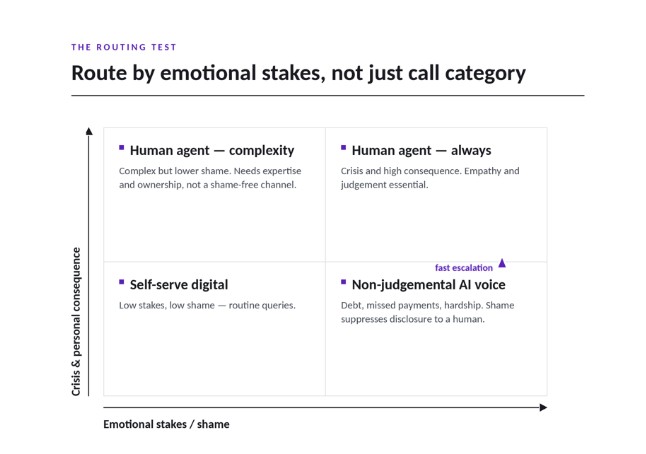
The limits are just as clear. When someone is in genuine crisis, highly distressed, or facing a decision with serious personal consequences, a human agent is essential. Even as people use more digital services, PwC found that 82% of consumers want more human interaction, not less. This was never really a contest between AI and human agents. The question worth asking is what a particular interaction needs, and which channel is better placed to handle it.
At Sabio, we start with the interaction itself before we reach for the technology. Working out where a non-judgemental channel does the real work, and where human empathy is irreplaceable. This is how we help organisations close the disclosure gap and meet their Consumer Duty obligations.
We’d love to have a conversation with you about it.