



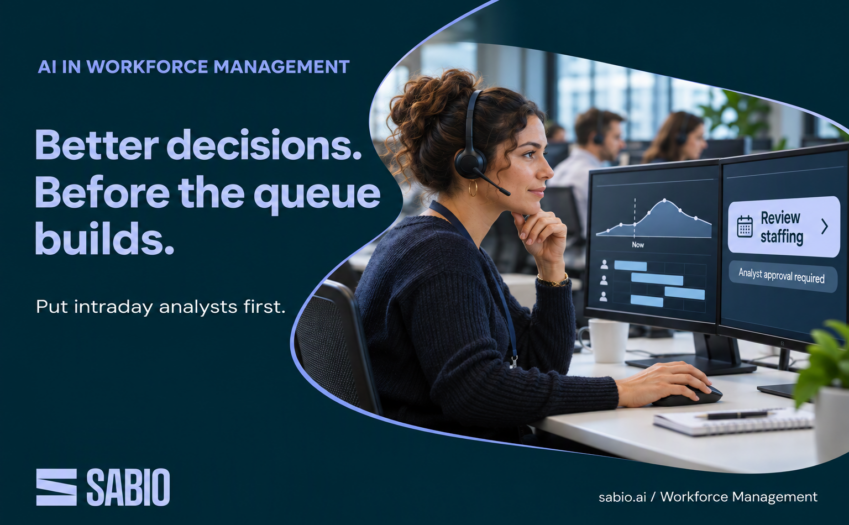
AI has the potential to transform Workforce Management, but where should organisations focus their investment first? Forecasting, scheduling and intraday management all present opportunities, however, for me, the intraday analyst role arguably offers the greatest opportunity for immediate, measurable impact.
The Intraday Challenge
Unlike forecasting and scheduling, which operate primarily around planned activities, intraday management is a continuous, dynamic process. Analysts must constantly monitor service levels, staffing availability, demand fluctuations, adherence, conformance and operational performance, often across multiple channels, queues and skills.
When performance deviates from plan, analysts need to identify the cause, assess the impact and determine the most appropriate corrective action.
This is where significant effort is consumed. Analysts frequently navigate multiple dashboards, interrogate reports, compare actual performance against forecasts and manually assess potential interventions.
Most organisations are data rich, insight poor so the challenge isn’t necessarily a lack of information. It’s the time required to turn that information into actionable decisions.
Moving Beyond Automation to Intelligent Decision Making
AI offers an opportunity to fundamentally change how intraday analysts operate.
Rather than simply automating existing processes, AI can continuously analyse operational data, identify emerging risks and recommend appropriate interventions.
Imagine an intraday analyst being able to ask:
- Why is service level deteriorating in a particular queue?
- Which activities can be rescheduled to recover staffing capacity?
- What is the likely impact of moving five agents between skills?
- Are today’s performance issues driven by demand, staffing or adherence?
- What are the main call drivers for today?
An AI-powered intraday assistant could provide contextual answers in seconds, supported by operational evidence and recommended actions.
Importantly, this isn’t about replacing the intraday analyst. It’s about shifting their role from manually investigating problems to making informed operational decisions.
Improving Accuracy and Efficiency
The real opportunity extends beyond productivity.
Traditional intraday management is often reactive. By the time an analyst identifies a problem, investigates its cause and implements corrective action, service performance may already have deteriorated further.
AI can help organisations become more proactive by identifying patterns, detecting anomalies and anticipating emerging staffing or service risks.
Combining real-time operational information with predictive analytics and intelligent recommendations creates opportunities for earlier, more consistent interventions.
Start Where AI Can Make a Difference Today
Forecasting and scheduling will undoubtedly benefit from AI innovation. However, intraday management combines high frequency decision-making, operational complexity and immediate business consequences.
That’s why the intraday analyst should be one of the first roles organisations look to augment with AI.
The objective shouldn’t simply be to make intraday analysts work faster. It should be to help them make better decisions, earlier, with greater confidence and measurable operational impact, leading to better business outcomes.