



‘Deflection’ never saved money, it deferred it. You pay later, out of a different budget where nobody traces it back
One of the first things we often do in a customer meeting is play their own customer experience back to them. It gets a few sheepish looks from around the table, and you can see why none of them have a desire to make eye contact during this. It’s usually several minutes before a caller has the chance to speak to anyone, and in that time, they are told at least twice, sometimes three times, that they would be better off somewhere else. (Side note this is possibly a big reason why the average disconnection in the IVR rate averages 30%.)
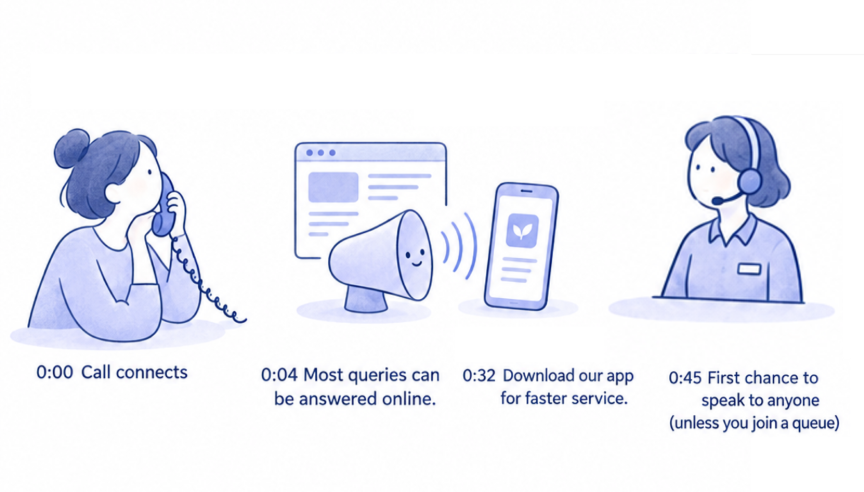
Nobody in the room designed that message to be hostile. Each was added on their own, for a sensible reason, often years ago by someone who no longer works there. But heard end to end, in a quiet room, it stops sounding like a service and starts sounding like a door being held shut.
If we were designing these systems from scratch today, with no tech debt to carry, you would still build self-service. What you would not build is a recorded message that tells a caller to go elsewhere before anyone has asked what they want. That exists because it was once the only option, and because too much now depends on it.
So my opinion is blunt. Ditch it.
The industry called it containment, or self-service adoption. Whatever the label, the mechanism was the same: keep the customer away from the conversation and count the calls that never arrived as a win.
The thinking behind deflection is last century
Voice has always been the hardest channel to automate and the most expensive to staff, so keeping people out of it was the only realistic lever available. Attempts at automation were technically limited too. Old systems could route a call but never finish one, which left the choice between a long queue and a deflection. Given that, deflection was the right call.
What has changed is not the price. To put it bluntly, agentic voice costs more per interaction than an IVR menu. What it does differently is finish the conversation rather than route it. I’ve watched this work over the last six months in systems I’ve helped customers deploy, where the AI holds a real conversation and, given the tools to act, resolves the thing the customer rang about. Not simply signpost them somewhere else.
Gartner expects agentic AI to be autonomously resolving 80 per cent of common service issues by 2029, with a 30 per cent cut in operating costs. Whether or not that number lands, it puts a shelf-life on the deflection business case, which makes the original decision worth re-opening. That is the hard part. The savings were banked years ago, in headcount and in budgets, so a deflection carrying a quarter of your demand is holding weight now. Nobody gets credit for re-opening a settled business case, and nobody wants to be the person who absorbed the volume mid-quarter. But the case often wasn’t built on a holistic view. The cost of what deflection creates sits in other budgets entirely, and nobody is ever asked to add them up.
What deflection was hiding
I want to reiterate that deflection is not resolution.
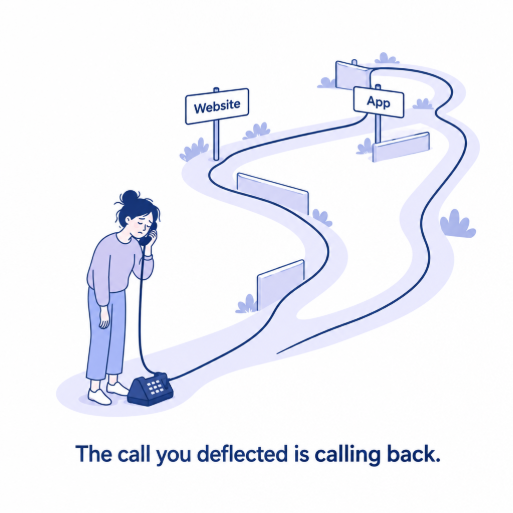
A deflected customer is a deferred one. They try the app, fail, and ring back… except now they are angrier, longer to handle, and now owed an apology as well as an answer. In The Effortless Experience, CEB found the same pattern across 97,000 customers – the customer who tries self-service, fails and switches channel is a lose-lose for both sides. Seddon named it failure demand and put it at 40 to 60 per cent of all demand in conventional command-and-control service organisations. It fundamentally questions whether deflection really removes cost or just hides it.
Concerningly, your own reporting is unlikely to show you any of this. Wrap-up codes are chosen in five seconds under handle-time pressure, so the data describing your demand is the least reliable data you own, and it is the data the deflection business case was built on.
Why deflection still gets defended
The pushback is usually two things:
- Plenty of customers would rather not talk to anyone
- Cost per contact is real
Whilst both are true, I would argue that neither succeeds in defending deflection as soon as we take a look under the hood of the data points.
A customer who opens the app because they prefer the app is not being deflected, they are being served. The test is whether they chose the channel or were pushed out of the one they chose. On cost, deflection never saved money, it deferred it. You pay later, out of a different budget where nobody traces it back. Cost per contact is a real number attached to the wrong unit; the unit that matters is cost per task finished.
Which is the actual problem.
Deflection rate says it worked, cost per contact says it was cheap, and neither asks whether the customer got what they came for. So, I would argue that we need to retire deflection rate and report bounce-back instead so we know for anything you still displace, count how many come back within seven days.
The untapped opportunity if we commit to ditching deflection
Removing deflection presents opportunities outside of customer satisfaction. It would mean that every unit of demand ends in its original channel of demand. And once you can see the cause, you can act on it. When we deep-dive customers’ data we often uncover things that should never exist:
- a confusing bill
- a broken link
- a letter that raises more questions than it answers.
Fix the cause and the contact disappears.
Interested in ditching deflection?
Are you interested in exploring how to use AI to help you ditch deflection? If so, we’d love to help. Why not visit our site today and build your own voice AI prototype?