


Scaling AI Is Not a Technology Question. It Is a Governance Question.

Almost every organisation now uses multiple AI applications. It usually starts the way SaaS did: a department has a problem, a tool is bought, and early results arrive quickly. Then costs climb, nobody knows exactly what happens to the data, and three departments are running three different tools for the same purpose.
My view: AI governance is not a brake on innovation. It is the precondition for scaling. Without governance, you do not scale faster. You mainly scale risk.
AI adoption is accelerating. Across organisations, new applications are introduced to improve efficiency, customer experience and decision-making.
But, more often than not, it’s not the technology that is the biggest challenge to a successful roll-out.
Take this example.
A department identifies an opportunity, selects a solution and starts implementing it. Early results may look promising. But as adoption grows, questions emerge: Who owns the application? How do we measure success? Who decides whether it can scale?
These are not primarily technical questions. They concern how organisations make decisions, manage risks and adapt to change.
At Sabio, we believe AI governance should not slow innovation down. It should create the conditions to scale it responsibly.
The challenge is not knowing what to do. It is knowing how to do it.
In our work with organisations exploring AI, we encounter situations where technology has been selected before its wider organisational implications have been fully considered. Businesses want to move quickly and demonstrate value. Yet AI changes how people work and where responsibilities sit.
The real challenge is not whether organisations have AI governance policies. It is whether they have the structures, capabilities and decision-making processes to put those policies into practice. That means knowing how decisions are made, who is involved, how risks are addressed and what happens when requirements change.
Governance becomes meaningful when organisations can answer these questions consistently and act on the answers.
Six questions to turn AI governance into action
We believe organisations benefit from reviewing their AI initiatives through six connected perspectives. The aim is not another compliance exercise, but an honest reflection on what works and what needs to improve. AI adoption can advance much faster than the organisation’s ability to govern it. The wider that gap becomes, the harder responsible scaling gets.
1. Understand where you stand
Map AI applications, purposes, owners, data and expected outcomes, including tools introduced outside formal IT processes. Action: Create a baseline inventory and flag missing ownership or duplication.
2. Identify organisational gaps
Review approval processes, accountability, risk assessment and monitoring. Action: Turn gaps into an improvement backlog with owners, priorities and deadlines.
3. Evaluate where AI adds value
Consider business value, data quality, human impact and whether people can intervene. Action: Compare alternatives, define acceptable use and agree success measures before selecting technology.
4. Develop the right capabilities
Business leaders, operational teams and control functions need the knowledge to recognise opportunities and limitations. Action: Identify skill gaps and provide role-specific training and realistic scenarios.
5. Embed governance into decisions
Governance belongs in business decisions, not only at final sign-off. Action: Establish clear decision rights and multidisciplinary review within existing delivery processes.
6. Continuously review and improve
Approval is not the end. Systems, requirements and risks evolve. Action: Monitor outcomes, set intervention thresholds and reassess material changes.
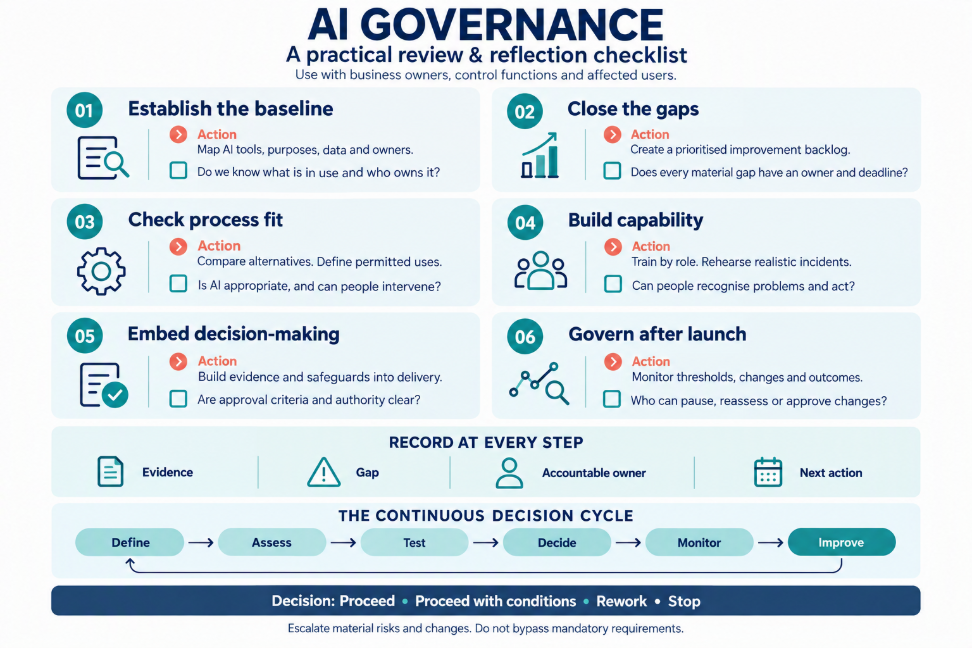
Figure 1. WHAT SHOULD WE ASSESS? Six governance areas for review, reflection and customer conversations.
From assessment to action: making AI governance work in practice
The six areas tell us what to assess. The next question is how to act on what we learn. We recommend a pragmatic path connecting assessment, decisions and continuous learning:
Assess the current situation. Review the six areas with business owners, control functions and affected users. Capture evidence and gaps.
Prioritise improvements. Separate issues that block deployment from enhancements that can follow. Assign accountable owners and realistic deadlines.
Agree who decides. Define approval authority, escalation routes and the evidence required for each decision.
Test through a controlled pilot. Integrate safeguards, testing and stakeholder feedback into Agile delivery cycles.
Review and adapt. Monitor outcomes and thresholds, reassess changes and feed lessons into the next iteration.
The objective is a repeatable process that grows with the organisation’s AI ambitions, not a complex structure overnight.
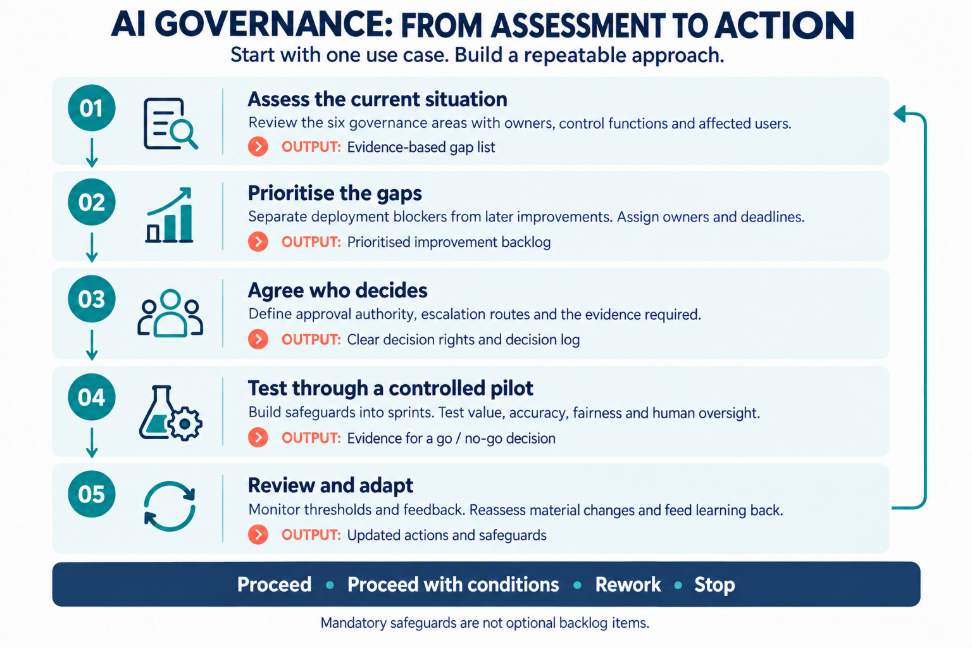
Figure 2. HOW DO WE TURN THE ASSESSMENT INTO ACTION? Five practical steps, decision points and continuous feedback.
How do we make decisions without slowing innovation?
An Agile approach can help, provided governance is embedded in delivery rather than left to the final approval meeting. Teams can define, assess, test, decide, monitor and improve throughout the lifecycle.
For higher-impact applications, a multidisciplinary group should consider purpose, business value, human impact, fairness, human oversight, accountability, and governance and monitoring. These criteria inform a documented decision; they do not replace judgement. Essential safeguards cannot be traded away for efficiency gains.
A decision may be to proceed, proceed with conditions, rework or stop. The relevant authority must be clear, and unresolved mandatory requirements must block deployment.
Agile delivery shapes how we build and improve. Governance establishes whether we should proceed, under which conditions, and who is accountable.
What does this look like in practice?
Consider AI-driven quality monitoring in a contact centre. It could improve coaching consistency and reduce manual work. But who reviews a disputed assessment? Could outputs affect employee evaluations? How would unfair outcomes be detected?
These questions should be addressed before rollout. Operational management, IT, Legal, HR and employee representatives can help define acceptable use, safeguards and review procedures. A controlled pilot can then test accuracy, fairness, employee feedback and business value. Broader deployment follows only when agreed conditions are met. For example, if an AI application produces inconsistent results or fails to meet agreed performance criteria, the governance structure must have the authority to intervene, even when commercial pressure favours moving forward.
Responsible AI is not achieved through approval alone. It requires participation, measurable outcomes and continuous improvement.
A final thought
Policies, regulation and risk management matter. But successful AI adoption ultimately depends on connecting technology with people, processes and accountable decisions.
The question is no longer simply whether we can implement AI. It is whether we have organised ourselves to use it responsibly, effectively and sustainably.
As AI adoption accelerates, is your organisation’s ability to govern it keeping pace?
What challenges are you encountering? We welcome your perspective, whether in the comments on LinkedIn or through a direct conversation. We’re happy chatting wherever you’re most comfortable.