


The Discipline Behind Achieving a ‘Return on Intelligence’

Most AI business cases naturally start with efficiency. How many minutes can we save? How many interactions can we automate? How much cost can we remove?
Those returns matter.
But if AI reduces the cost of intelligence far enough, the bigger opportunity isn’t simply doing today’s work more cheaply. It’s doing things that previously didn’t make economic sense.
In customer experience, that could mean having more conversations.
Not more pointless contacts. Nobody needs another company finding a clever new reason to bother them.
More conversations that are actually worth having
A conversation that prevents a problem has value. One that retains a customer has value. One that identifies something they genuinely need has value.
And every one of those conversations creates something else: intelligence.
The more conversations we have with customers, the more we learn about what they need, where they struggle and what they value. Each interaction adds to a rich source of insight that can improve experiences, decisions and outcomes, for that customer and for the next one.
There’s a nice symmetry in that. We spend intelligence to have these conversations, and the conversations give us intelligence back.
This is where ‘Return on Intelligence’ becomes useful as a way of thinking about token spend.
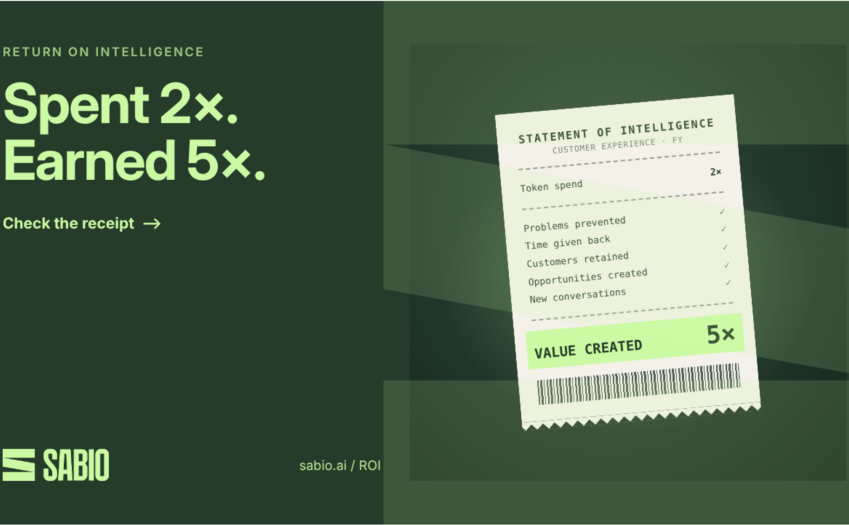
Imagine your AI consumption doubles next year. Viewed purely as a technology cost, that could look worrying.
But before trying to bring it down, I’d want to know what happened to the return.
If spending twice as much on intelligence has created five times the value, reducing consumption could actually destroy value.
And the opposite is equally important.
If token consumption is growing and we can’t point to better outcomes, greater productivity, lower costs, improved customer experience or additional revenue, then we absolutely should challenge the spend.
That’s the discipline behind Return on Intelligence.
It isn’t an excuse to spend more on AI. It’s about making sure the intelligence we’re buying earns its keep.
And it changes where we start.
Where are the conversations we’re not having today? Which customers could we help earlier? Where are we rationing customer attention because it has historically been too expensive?
What could we do that didn’t make economic sense when every intelligent interaction required human time?
And, crucially, what is that outcome worth?
Once we understand that, we can work backwards and decide how much intelligence it makes sense to consume.
We’ve spent decades designing customer operations around a world in which intelligence was scarce and expensive.
We now need to start thinking about what customer experience looks like when it isn’t.
And that takes me back to the AI bill we started with.
If consumption has doubled, perhaps that’s a problem.
But perhaps it isn’t.
The number on the bill only tells you what you spent. It tells you nothing about whether you should have spent it.
To know that, you need to look at what happened as a result.
How many problems did we prevent? How much time did we give back? How many customers did we retain? How many opportunities did we create? And how many valuable conversations happened that simply wouldn’t have happened before?
Not how much intelligence did we consume?
What did that intelligence make possible?
That’s what I’m interested in.